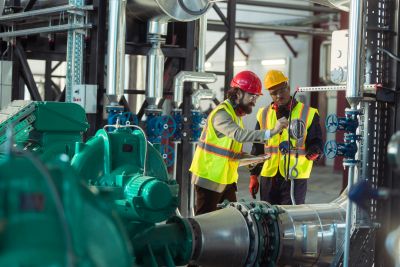
Mechanical and other non-electrical equipment can present significant ignition risks in hazardous areas, particularly where equipment is ageing, has been modified or was never designed with modern explosion protection requirements in mind.
The potential for ignition is not limited to electrical equipment. Pumps, fans, gearboxes, conveyors, mixers, agitators and other moving equipment can create potential ignition sources through hot surfaces, friction, impact, static electricity or mechanical failure.
Vital Ex carries out Mechanical Equipment Ignition Risk Assessments (MEIRAs) to identify these risks and help organisations demonstrate that equipment can continue to operate safely within hazardous areas, while supporting compliance with DSEAR and recognised industry standards.
When is a MEIRA required?
A Mechanical Equipment Ignition Risk Assessment may be appropriate where:
- Mechanical or non-electrical equipment is installed within a classified area
- Existing or legacy equipment does not have the certification or documentation normally expected for hazardous area use
- DSEAR compliance needs to be demonstrated
- Existing plant is being modified
- Equipment replacement is being considered
- Ignition risks require independent assessment
Our assessments help organisations understand whether existing safeguards are suitable, whether additional controls may be needed and whether equipment can continue to operate safely within its current environment.
Benefits of a MEIRA
A MEIRA can help you:
- Demonstrate DSEAR compliance
- Identify credible ignition risks and appropriate controls
- Support the safe operation of mechanical equipment
- Reduce operational risk
- Avoid unnecessary equipment replacement
- Improve confidence in hazardous area management
A good MEIRA is not simply a checklist exercise. It requires sound engineering judgement to determine whether credible ignition sources exist, whether existing safeguards are effective and whether equipment can continue to operate safely within a hazardous area.
Where replacement, modification or additional controls are necessary, the assessment also provides the engineering basis for that decision.
How we assess mechanical ignition risk
Our consultants assess equipment in the context of how it is actually used and the hazardous area in which it operates. The assessment typically considers:
- Equipment design and operating conditions
- Potential mechanical ignition sources
- Foreseeable faults and failure modes
- Existing safeguards, inspection and maintenance arrangements
- Hazardous Area Classification and operating environment
- Practical engineering measures where additional risk reduction is required
Our assessments apply the principles of BS EN ISO 80079-36 and BS EN ISO 80079-37, alongside DSEAR requirements and recognised industry good practice.
Mechanical ignition risks should always be considered in the context of the hazardous area classification and the actual operating conditions of the plant, rather than in isolation. The outcome is a practical engineering assessment with clear, documented recommendations to support safe and compliant operation.
What equipment can be assessed?
MEIRAs can be carried out on a wide range of mechanical and non-electrical equipment used in hazardous areas, including pumps, fans, gearboxes, conveyors, mixers, agitators, valves, actuators and other rotating or process equipment.
The assessment is based on how the equipment is actually used, the faults that could reasonably occur and the hazardous area in which it operates.
Why choose Vital Ex for your specialist mechanical equipment assessment?
Older or modified mechanical equipment does not always fit neatly into today's certification framework. The question is not simply whether a certificate exists, but whether the equipment presents a credible ignition risk in the hazardous area in which it is actually operating.
Vital Ex provides independent, evidence-based assessments to answer that question. We combine practical hazardous area expertise with a detailed understanding of mechanical ignition risks, DSEAR requirements and explosion protection standards. Our assessments are tailored to the specific plant, equipment and operating conditions rather than relying on generic assumptions.
This provides a clear engineering basis for determining whether equipment can remain in service, whether additional safeguards are required or whether replacement is the most appropriate solution.
Where the suitability of electrical equipment is also uncertain, a separate Fitness for Purpose Assessment may be appropriate. We can also support clients with Hazardous Area Classification and wider DSEAR Risk Assessments where these form part of the same compliance review.