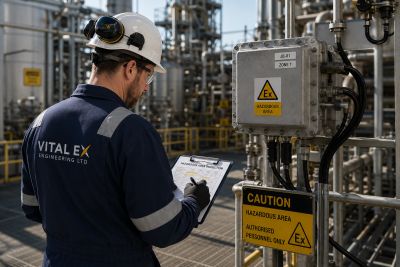
Many industrial sites continue to operate explosion-protected electrical equipment installed before modern ATEX and UKEX certification requirements, or where certification plates, drawings and original documentation have been lost over time.
That doesn't automatically mean the equipment needs to be replaced.
Vital Ex carries out Fitness for Purpose Assessments (FFPAs) to determine whether existing electrical equipment can continue to operate safely within hazardous areas. Our assessments provide a documented engineering basis for continued use, modification or replacement while supporting DSEAR compliance and hazardous area management.
When is an FFPA required?
A Fitness for Purpose Assessment may be appropriate where:
- Existing or legacy Ex equipment does not have the certification, marking or documentation normally expected today
- Equipment identification plates are missing, damaged or illegible
- Original certification or technical records have been lost
- Equipment has been modified, repaired or refurbished
- Imported equipment has uncertain or incomplete certification
- Existing installations require technical justification for continued operation
- Equipment replacement is being considered but may not be necessary
An FFPA helps establish what is known about the equipment, whether its explosion protection remains suitable for the hazardous area and whether any further controls or remedial actions are required.
More than a paperwork exercise
A missing certificate does not automatically mean that equipment is unsafe, just as the presence of a certificate does not guarantee that it remains suitable for the hazardous area in which it is operating.
A good Fitness for Purpose Assessment therefore goes beyond checking paperwork. It requires engineering judgement to understand how the equipment is constructed, the explosion protection concept being relied upon, its current condition and whether it remains suitable for the environment and duty in which it is being used.
Where the evidence supports continued operation, the FFPA provides the documented engineering justification for that decision. Where modification, additional controls or replacement are required, the assessment provides the basis for those actions too.
Evidence-based decision making is particularly important where replacement of Ex equipment is being considered. Our article The Most Expensive Ex Equipment is the Equipment You Never Needed, explores why engineering assumptions can sometimes lead to unnecessary cost and complexity.
How we assess electrical equipment
We carry out a structured engineering review based on the individual equipment, its installation and the hazardous area in which it operates. The assessment typically considers:
- Equipment design and construction
- Explosion protection concept and method
- Equipment marking and available certification
- Installation quality and physical condition
- Intended operating duty and environmental conditions
- Hazardous Area Classification
- Previous modifications, repairs or maintenance history
- Relevant standards and available technical evidence
Where appropriate, additional inspection, testing or technical investigation may also be undertaken.
Assessments are undertaken with reference to applicable BS EN IEC 60079 standards, DSEAR requirements and available technical evidence relevant to the equipment under review.
The outcome is a clear, documented engineering assessment setting out whether the equipment remains suitable for continued service and identifying any remedial actions that may be required.
What are the benefits of an FFPA?
A Fitness for Purpose Assessment can help you:
- Demonstrate DSEAR compliance
- Provide engineering justification for the continued use of legacy equipment
- Resolve gaps in certification or technical documentation
- Avoid unnecessary equipment replacement
- Support inspection, maintenance and asset management decisions
- Improve confidence in ageing hazardous-area installations
- Provide documented technical evidence for internal assurance, auditors or regulators
For older sites in particular, this can help organisations make proportionate decisions based on the actual equipment and risk rather than assuming that missing documentation automatically means replacement.
Why choose Vital Ex for your specialist electrical equipment assessment?
Legacy electrical equipment rarely presents a simple yes-or-no certification question. The real issue is whether the equipment remains suitable for the hazardous area in which it is operating and whether there is sufficient engineering evidence to support that conclusion.
Vital Ex provides independent, evidence-based Fitness for Purpose Assessments to answer that question.
We combine practical hazardous area experience with a detailed understanding of explosion-protected electrical equipment, DSEAR requirements and relevant international standards. Every assessment is based on the actual installation, operating conditions and available technical evidence rather than generic assumptions.
This provides a clear engineering basis for determining whether equipment can remain in service, whether remedial action is required or whether replacement is the most appropriate solution.
Where mechanical or other non-electrical equipment also requires assessment, a Mechanical Equipment Ignition Risk Assessment (MEIRA) may be appropriate. We can also support clients with Hazardous Area Classification and wider DSEAR Risk Assessments where these form part of the wider compliance review.